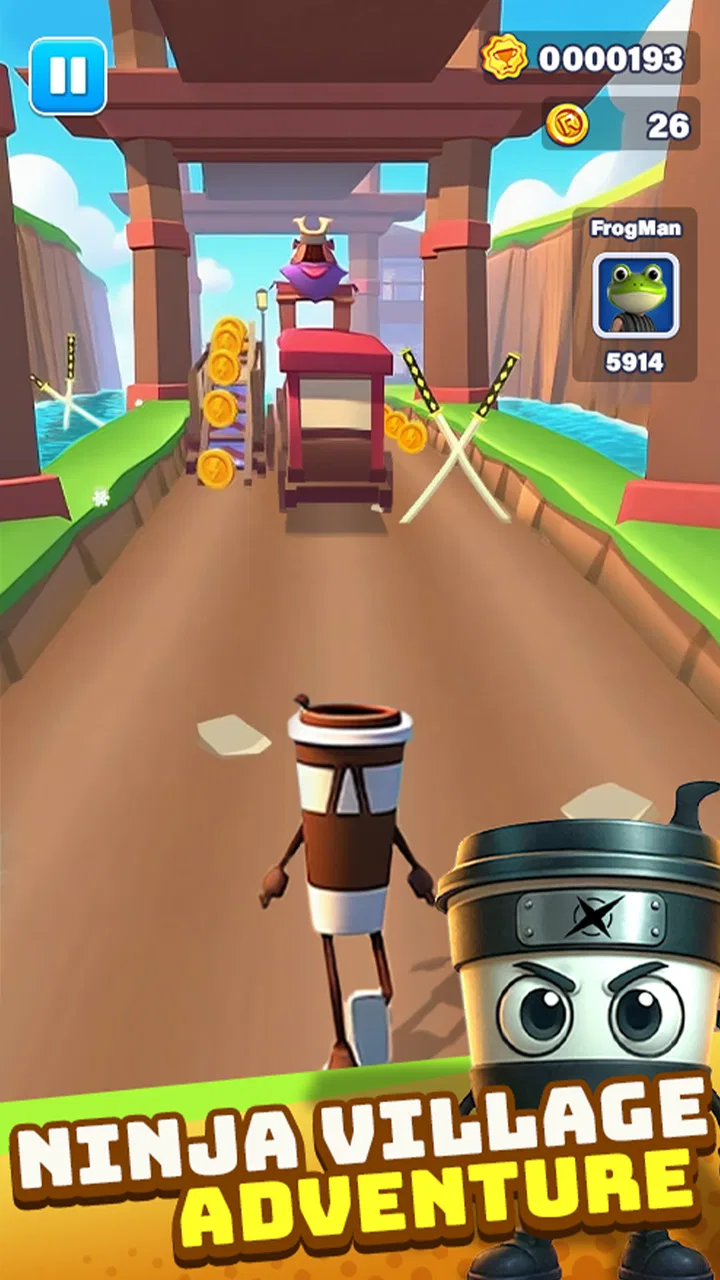
Subway Runner: Parkour Game
- 4.0
- Rating
- 10.00M
- Installs
- Free
- Price

 Analysis by App-foxy
I approached Subway Runner: Parkour Game as the kind of quick arcade title I could open without planning a long session. Its basic appeal is easy to understand: keep moving through a subway setting, avoid trains and other hazards, and work toward unlocking jet planes. After spending time with it, my view is that it works best as a simple reflex game for short breaks, not as a deep runner designed to replace more feature-heavy alternatives.
That distinction matters. The game is free to start, easy to understand, and suitable for Everyone, but its enjoyment depends heavily on whether you like repeating quick runs to improve your reactions. I found the central loop immediately accessible, while the long-term motivation felt more limited than in the biggest endless-runner games. If you want something you can learn in moments and play with one hand during a spare minute, it has a clear purpose. If you expect a large progression system or a highly varied arcade experience, you may reach its limits sooner.
How the subway-running loop feels in everyday play
The first strength is the low barrier to entry. A subway chase gives the game an instantly readable setting, and the objective does not need a long tutorial to make sense. I could begin a run, focus on the route ahead, and understand that survival depended on reacting before trains or obstacles closed off my path. That directness is valuable on a phone because there is little setup between opening the game and actually playing.
You May Also Like

 Blood Strike: 2.5 Anniversary
Blood Strike’s Loadouts Turn Every Drop Into a Tactical Gamble
A close look at Blood Strike’s custom loadouts: how fast access to signature weapons reshapes its battle royale rhythm, rewards preparation, and narrows the gap between fights.

 Pandora - Music & Podcasts
Pandora’s Music Is Easy to Start, but Harder to Recover
Pandora’s strength is its low-effort path from a seed to a station. Its weak spot is how much confidence it asks you to place in connection, setup, and quiet recovery.

 8 Ball Pool
 Is Built on Rivalries, Rematches, and Routine
A close look at the rivalries, rematches, shared routines, and unanswered safety questions that turn a quick pool match into a persistent mobile community.

 Samsung Music
’s Quiet Strength Is Playing What You Already Own
Its reach comes less from spectacle than from dependable access to a personal library. That simplicity is both the app’s strongest retention engine and its ceiling.

 AccuWeather: Weather Radar
AccuWeather Review: A Quick, Clear Forecast for Everyday Decisions
For everyday plans, the best forecast is the one you can understand quickly. AccuWeather makes rain timing, radar, and local conditions easy to act on, with a few trade-offs.

 Hill Climb Racing
Why Hill Climb Racing Still Turns Crashes Into One More Run
A tiny car, a bumpy hill and one more upgrade: Hill Climb Racing keeps resurfacing because its simple chaos makes every near-miss feel personal.
More From Our News Desk



In a realistic everyday situation, I would use it while waiting for a bus, taking a short break from work, or sitting down for a few minutes before an appointment. It suits those moments because a run can be treated as a self-contained attempt rather than a commitment to a long story. I also like that the subway theme gives the action a stronger identity than a completely abstract track. The danger feels connected to the environment, even when the underlying task remains familiar arcade reflex play.
The most important skill is not simply tapping quickly. I found that successful runs depend more on reading the next section early and choosing a safe route before the immediate obstacle becomes unavoidable. That creates a useful rhythm: watch the track, anticipate the train, make the move, then reset your attention for what follows. Players who react only at the last instant will probably have a harder time than those who keep their eyes farther ahead.
One practical tip is to avoid treating every opening as an invitation to move. In a runner built around subway lanes and incoming trains, unnecessary movement can be as dangerous as hesitation. I had better results when I made deliberate changes instead of constantly shifting position. That approach also makes the game feel less random, because each mistake becomes easier to examine: did I move too late, choose the wrong lane, or fail to notice the next hazard?
The jet-plane unlocks add a useful goal beyond simply surviving one more moment. They give repeated runs a reason, especially for players who enjoy collecting or gradually opening new rewards. I would not describe that objective as a complete progression framework by itself, but it does provide a clear milestone. When a game is designed for short sessions, a visible unlock target can be enough to encourage another attempt after a disappointing run.
That system also creates a small trade-off. Players who enjoy chasing a specific reward may find the structure motivating, while players looking for constant novelty may see the unlock as a destination rather than a deep change to the game. I recommend treating the jet planes as a bonus objective, not as the sole reason to keep playing. The moment-to-moment dodging needs to be enjoyable on its own, because no unlock can compensate for a runner whose basic movement does not hold your attention.
What makes the controls approachable
The game’s arcade design is strongest when I play with a simple goal: survive a little longer than last time. There is no need to memorize a complicated control scheme before trying to improve. That makes it approachable for casual players and younger users, which fits its Everyone content rating. It is also the sort of game I could hand to someone who does not regularly play mobile games without needing to explain a large set of rules.
At the same time, approachable does not mean effortless. Subway hazards demand attention, and the short distance between noticing danger and responding can make a run end quickly. That tension is useful because it gives the game a clear learning curve at the level of personal timing. I began to focus less on reacting emotionally to a train and more on scanning the route in advance. For me, that was the difference between random attempts and purposeful improvement.
Another helpful habit is to keep sessions focused rather than playing while distracted. This is not a relaxed background game where I can look away for long periods and still expect to recover. A notification, conversation, or moment of divided attention can be enough to ruin a run. I would therefore recommend it for short, deliberate breaks rather than for multitasking while watching something else.
The game can also work as a quick reaction exercise, although I would not confuse that with a formal training tool. Repeatedly identifying the safest path and responding under pressure can sharpen familiarity with the game’s pace. The benefit is specific to its own obstacles and timing, so I see it as a playful challenge rather than a general claim about reflex improvement.
Where the experience starts to feel limited
The main weakness is depth. The core idea is clear, but a runner built around dodging subway dangers can become repetitive if the surrounding progression does not offer enough reasons to return. I enjoyed the first sessions more when I was still learning the timing and pursuing the next unlock. Later, the appeal depended increasingly on whether I personally wanted to beat my previous performance.
That is not a fatal problem for an arcade game. Many good mobile titles are intentionally narrow, and a focused loop can be preferable to a cluttered one. Still, I think readers should set their expectations correctly. This is not the best choice for someone who wants a narrative campaign, a large collection of distinct modes, or the strategic variety found in more elaborate mobile games. Its strength is immediacy, not complexity.
The free model is another point to consider. The game is free, with optional in-app purchases priced at less than a dollar per item. That keeps the entry cost low, which I appreciate when testing a short-session arcade title. However, any player who is sensitive to spending prompts should remember that small purchases can accumulate if made repeatedly. My advice is to decide in advance whether the base experience is enough for you and avoid treating every available item as necessary progress.
Because the game is aimed at Everyone, it is a reasonable option for a broad age range, but adults should still judge whether the simple loop matches the player’s expectations. A child who enjoys rapid obstacle dodging may return to it often, while another player may lose interest once the initial novelty fades. The age rating tells you the intended content level; it does not guarantee that every player will find the progression satisfying.
I also would not choose it when I need a calm game. The subway setting and train hazards make attention the priority, and the pressure comes from having to respond quickly. For relaxing puzzle play, a turn-based title would be a better fit. For a richer action experience, a more established runner with broader customization or varied challenges may offer stronger long-term value. Subway Runner is most convincing when judged on speed and simplicity rather than against every type of mobile game.
Who should download it, and who should skip it
I think this game is a good match for casual arcade players who want a fast start and a familiar objective. It is especially suitable for someone who likes testing personal timing, repeating short runs, and working toward a concrete unlock such as the jet planes. It can also be a sensible first runner for a player who feels overwhelmed by games with elaborate menus, stories, or complicated upgrade trees.
It is less suitable for players who need a strong sense of discovery after the first few sessions. If your favorite mobile games keep you engaged through extensive customization, changing mission types, or a large social layer, this may feel too focused. I would also skip it if you dislike replaying similar runs to improve. The game asks you to find satisfaction in incremental progress, and that is a personal preference rather than something a feature list can solve.
The technical requirements make it accessible to a wide range of Android users. It supports Android 7.0 and later, and the current version is 1.6.2. I would still check that the device has enough free space and that the operating system is supported before installing, especially on an older phone. The important point is that it is not positioned only for the newest hardware, which makes its straightforward arcade format easier to recommend to people using a modest Android device.
Happy Go Game is the developer behind the title. The game was released on April 7, 2025, so I see it as a relatively recent entry rather than a long-established classic. Its store summary captures the basic direction, but the practical question is whether that direction fits your habits. If you want a game that can occupy a few spare minutes without demanding a long tutorial, the answer is more likely to be yes.
The current reception is mixed but reasonably encouraging: it holds a 3.7 average from around eleven thousand ratings, with more than ten million installs. Those figures suggest that the concept has found a substantial audience, while the rating also hints that it will not satisfy everyone equally. I would read that combination as a reason to keep expectations moderate. Popularity supports the idea that the entry point works, but it does not turn a simple runner into a deep arcade platform.
One useful way to decide is to ask what you want from your next mobile game. If the answer is “something I can open, understand, and play immediately,” this title deserves consideration. If the answer is “a game I can study for weeks and keep discovering,” I would look elsewhere. That simple test is more helpful than judging it by the standards of a completely different genre.
My final take after weighing the trade-offs
I came away seeing Subway Runner: Parkour Game as a competent, focused time-filler with a clear audience. Its subway hazards create an understandable challenge, the jet-plane objective gives runs a destination, and the controls are approachable enough for casual players. I especially value the way it rewards looking ahead rather than panicking at the nearest train. That small shift in play makes the experience feel more skill-based and gives repeated attempts a practical purpose.
Its limitations are equally clear. The loop may become repetitive, and the progression is unlikely to satisfy players searching for extensive variety. The optional purchases are inexpensive individually, but players should not assume they are essential to enjoying the free starting experience. I would also avoid recommending it as a relaxing or story-driven game, because its appeal comes from quick attention and repeated arcade attempts.
For me, the best recommendation is specific: install it if you enjoy short, focused runs and want a free subway-themed challenge that can be learned in minutes. Give it a pass if you need deep systems, a broad campaign, or constant changes in activity. Its real strength is convenience with just enough goal-driven replay to make a spare moment feel purposeful. That is a modest ambition, but the game generally understands it, and that makes it an easy pick for the right kind of player.
FAQs for Subway Runner: Parkour Game
01What is the main objective of Subway Runner: Parkour Game?
Subway Runner: Parkour Game is an endless runner where players navigate through a busy subway system. The main objective is to dodge obstacles, collect coins, and complete missions to achieve high scores. Players can unlock new characters and power-ups to enhance their gameplay experience. Strategic use of these elements can help players reach the top of the leaderboard.
02Is Subway Runner: Parkour Game free to play, and are there in-app purchases?
Yes, Subway Runner: Parkour Game is free to download and play. However, the game offers in-app purchases that include coin packs, character skins, and power-ups. These purchases can enhance the gaming experience by allowing players to progress more quickly or customize their characters. Players can choose to play entirely for free, with the option to purchase items if desired.
03What platforms is Subway Runner: Parkour Game available on?
Subway Runner: Parkour Game is available on both Android and iOS platforms. It can be downloaded from the Google Play Store for Android devices and the Apple App Store for iOS devices. The game is optimized for smartphones and tablets, offering a seamless experience across different screen sizes and operating systems.
04Are there any social features in Subway Runner: Parkour Game?
Yes, Subway Runner: Parkour Game includes social features that allow players to connect with friends. Players can compete on leaderboards to see who has the highest score and can share achievements on social media. These features add a competitive edge to the game, encouraging players to improve their skills and challenge their friends.
05Does Subway Runner: Parkour Game require an internet connection to play?
Subway Runner: Parkour Game can be played offline, making it convenient for players who want to enjoy the game without an internet connection. However, an internet connection is required for certain features such as in-app purchases, leaderboard updates, and social sharing. Offline play ensures that players can enjoy the game anytime, anywhere.
Pros
- Engaging graphics and smooth animations.
- Intuitive controls for easy gameplay.
- Variety of levels keeps it interesting.
- Regular updates with new features.
- Offline mode available for play anywhere.
Cons
- In-app purchases can be pricey.
- Ads can be frequent and intrusive.
- High battery usage during long sessions.
- Limited customization options for characters.
- Occasional lag on older devices.

Subway Runner: Parkour Game
Gallery